


[* Please take care with the volume — the loudness of the music may just scare you away! *]
It’s music time! Old-timey music, that is!
Also time to take a break from all the worries and woes of the world!
Do enjoy the musical diversion and history on tap here.
Tagalog:
PAKIUSAP (1921)
Natutulog ka man, irog kong matimtiman
Tunghayan mo man lamang ang nagpapaalam
Dahan dahan mutya, buksan mo ang bintana,
Tanawin mo't kahabagan,
Ang sa iyo'y nagmamahal.
Kung sakali ma't salat sa yama't pangarap,
May isang sumpang wagas,
Ang aking paglingap.
Pakiusap ko sa iyo kaawaan mo ako,
Kahit mamatay, pag-ibig ko'y minsan lamang.
Iniibig kita, magpakailan pa man.
English Translation:
SUPPLICATION
Though you sleep, my dearest one,
At least, oh, cast a glance upon the one who bids farewell.
Gently, my jewel, open the window,
And behold with compassion,
The one who loves you.
Should fortune and dreams be lacking,
There is one vow that is pure:
My devotion.
I beg you, have mercy on me,
Though I die, my love is but for you alone.
I love you, forever and always.
FILIPINO MELODRAMA IN SONG
The song “Pakiusap” by Francisco Santiago is a touching plea from a lover to his beloved who may be fast asleep. He implores her to open the window and gaze upon the one who loves her dearly. The words “Dahan-dahan mutya, buksan mo ang bintana, tanawin mo’t kahabagan” (“Gently, my jewel, open the window”) convey a strong sense of longing and desperation to be noticed and loved by the one he adores. He begs for her mercy and compassion, even if it means that he might die in the process. He declares his love for her will never fade, no matter how tough the circumstances may seem.
The overall theme of the song is about unrequited love and the struggle to obtain it. The singer yearns for affection from his beloved and asks for her to reciprocate his feelings. The lyrics are passionate, deeply moving, and infused with a sense of melancholy. Francisco Santiago successfully translates the angst of the poet’s feelings into a poignant and memorable melody.
Source.
Yes, perhaps the words conjure up a romantic scenario that goes a bit over the top, especially in our harsh and cynical age. Yet, they charmingly reflect the genteel Filipino culture and tradition in courtship back in the 19th to early 20th centuries. It was one of gentleness, non-confrontation, with no overbearing stance from the man when wooing a woman — to the contrary; the man implores the woman to pay him the smallest heed, and it goes both ways, too.
As the haunting melody shifts from a minor key to major, the singer’s pleading grows stronger as he sings, Kung sakali ma’t salat sa yama’t pangarap,… (Should fortune and dreams be lacking…).
This key shift forms the core musical structure of the kundiman (AKA cancion filipina, a plaintive Filipino art-song), and is what gives it a special melodic appeal.
This particular kundiman, with music written in 1921 by Francisco Santiago and the poetic Tagalog lyrics by José Corazón de Jesús, has become one of my fav old classical Filipino songs.
MUSIC SHEET COVER:
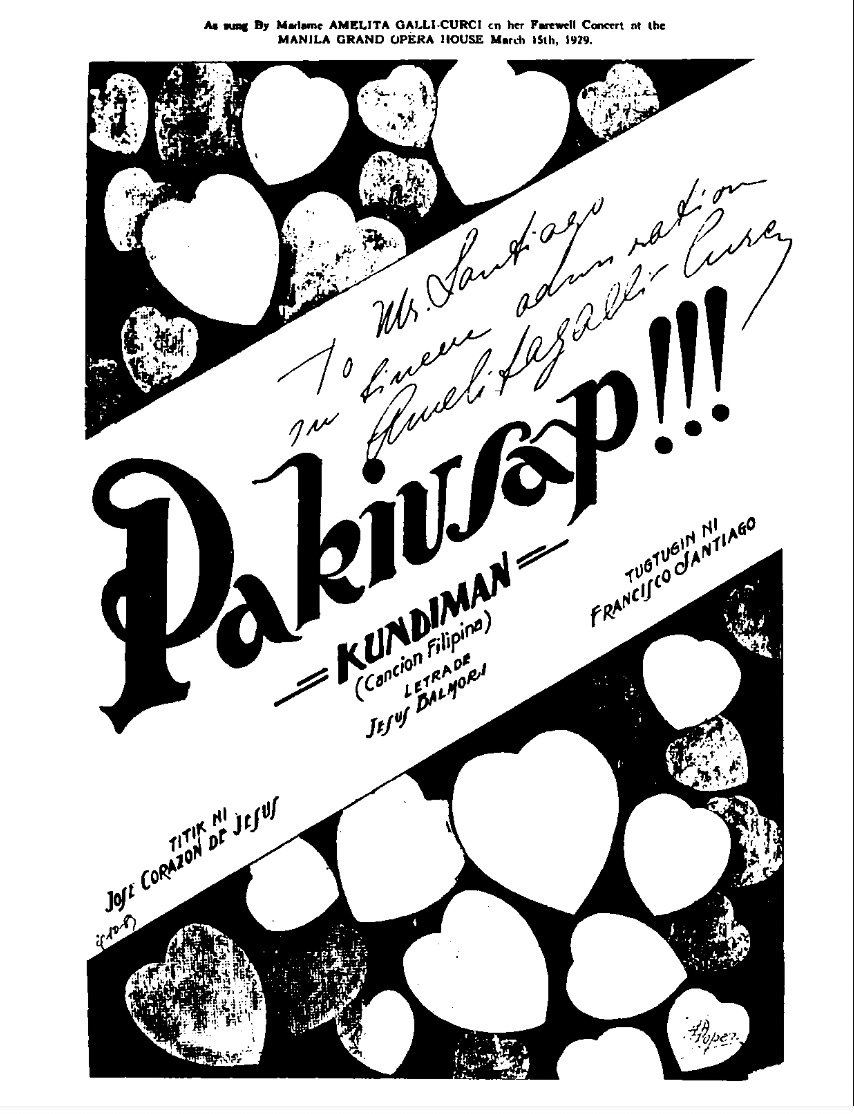
What a historic document this is! Why do I say that?
Take a good look at the comment at the very top, printed in tiny type:
As sung by Madame Amelita Galli-Curci in her farewell concert at the Manila Grand Opera House, March 15th, 1929.
(Source of the sheet music is one of the older music stores in Manila, Lobregat Music Store.)
And, oh my! — there’s also the dedication above the title written by Galli-Curci herself and addressed to “Mr Santiago” (the composer, of course). “In sincere admiration,” the singer writes.
Wow! Amelita Galli-Curci!
The name will draw blank stares from most people today. Yet Amelita Galli-Curci (1882-1963) was one of the foremost lyric coloratura sopranos of the early 20th century. She performed in operas and recitals across the continents, including the far-flung Philippines in those peaceful prewar years, reaching even as far south as Iloilo (this, per my pianist mom, who grew up there.). Recall that at the time, people could only have ships to take them on weeks-long voyages overseas, and on shorter trips between islands.
I can fully today understand my parents’ fondness for those quiet and happy pre-war years. Sadly, so many and so much was irreplaceably lost and destroyed during the awful Second World War!
For those curious, here are a few audio samples of Galli-Curci’s artistry:
https://music.youtube.com/watch?v=rADDUhzncHQ&list=PL3B2C8533B6BCE78E
I would’ve loved to hear her singing Pakiusap, for sure!
Galli-Curci wasn’t the only non-Filipino singer who liked this song well enough (and others, too) to come to Manila to perform it; there was also the Italian tenor, Arrigo Pola (1909-1999).
Pola counted Luciano Pavarotti as one of his students, and recorded a few kundimans in the Philippines. In the 1950s, he apparently was quite popular in the music-loving country.
Here’s his rendition of Pakiusap, with perfect enunciation of the Tagalog, just like a local! (Tagalog is great for operatic singing thanks to its wealth of open vowels — especially the ubiquitous “ah”.)
NOSTALGIA FOR A LOST ERA | A BELATED APPRECIATION FOR A SINGER
Funny what the years do to one… am thrown into an oddly nostalgic mood, but one longing for a distant period, beyond even that of my parents — but that of my grandparents in the early 20th century.
Pakiusap (Supplication) above is a fine example of the gentle, plaintive kundiman. In the title video above, soprano Sylvia la Torre (1933 - 2022) wonderfully evokes that era.
It came late in the day, but I finally recognized the rare vocal gifts of this late singer. I now consider her to be one of the Philippines’ greatest. (There are almost none of them alive today.)
For the longest time, she was known to me only as a funny, singing TV personality in a lighthearted noontime comedy-variety show popular in childhood (Oras ng Ligaya / “Time for Fun”). Thanks to a most effective US colonialist education-engineered molding of the mind, I was very dismissive of local talent, seeing singers of the West as inherently “superior”.
Well, no longer.
Locally known as the “Queen of Kundiman,” La Torre’s gift was revealed to silly ol’ me only after almost half a lifetime of listening to Western operatic fare. There’s her pitch-perfect and pure tone, loveliness of timbre, and well-controlled breathing — qualities rarely found in any singers today (the operatic kind are even rarer).
A hardworking gal all her life, she started out as a child actress in the capital’s pre-WWII vaudeville (bodabil) industry, then went into radio, and later, television and movies. In her youth, she sang at the 19th-century-era Manila Grand Opera House. This is the very same venue where the great international opera stars appeared back in the day (see Galli-Curci, above). (The structure has sadly long been demolished and replaced with a nondescript hotel in the history-oblivious Philippines).
Of note, Sylvia even bothered to take formal voice and music classes at the University of Santo Tomas Conservatory of Music, while also working full-time on radio and stage. She took no additional studies abroad, and needed none.
A FUN VIDEO
This is from 10 years ago, when the singer was 83 years old. Clearly, still possessing the ol’ singing chops, as she always cared for her voice and practised a few hours everyday. Sylvia’s granddaughter, Anna Perez de Tagle (who was born in and grew up in California, and just like her mom, was often serenaded by her grandma) shows off her grandma’s singing genes. Both are dressed in the traditional Filipino terno, (globally popularized by Imelda Marcos).
Granddaughter Impersonates Grandma: Sa Kabukiran
Here we see that the grande dame of kundiman remains the humorous entertainer. A devout, lifelong, practicing Catholic, she always exuded dignity and decorum in all she said and did.
For more:
Remembering the original OA, Sylvia La Torre
Considered as the ‘Queen of the Kundiman’ and the ‘First Lady of Philippine Television,’ she embodied the Filipino soul, whether through sorrowful songs or comic relief, with that unmistakable sterling voice that could summon both tears and laughter.
Edu Jarque


